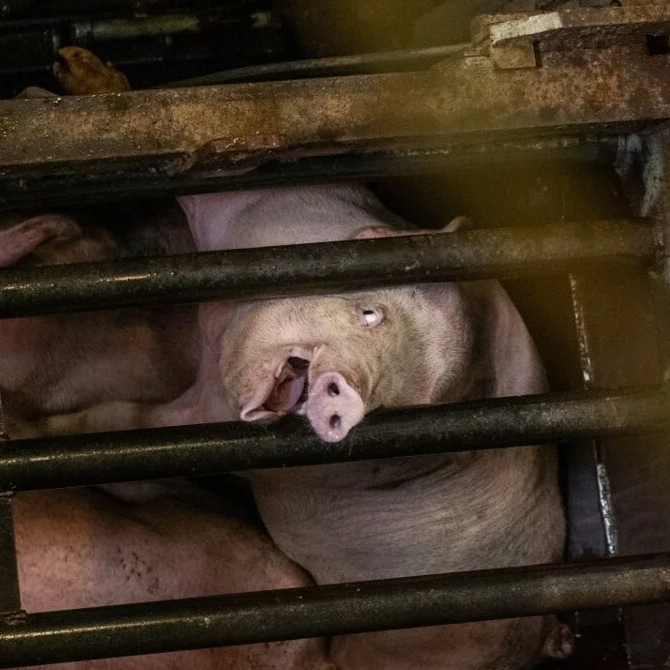
We are fooling ourselves.
A product with stars feels like a better choice. That can quickly make us believe the animal had a good life.
But animals with three stars are still used for meat, milk or eggs.
Afterwards, they are killed. The stars mainly make us feel better.
The differences are small.
The difference between one and three stars may seem large. In practice, it is often small.
An animal may get a little more space, enrichment or a softer place to lie down.
That helps somewhat. But the animal is still confined and treated as a product.
Even an animal with three stars is ultimately killed.
All animals end up at the slaughterhouse.
Welfare labels mainly concern life before death. But all of these animals are taken to a slaughterhouse.
There they are restrained, stunned and killed. In large slaughterhouses, this happens to many animals at the same time.
- At high processing speeds, mistakes can affect many animals.
- Transport, waiting and stunning cause stress and carry a risk of pain.
- Killing an animal is never kind to that animal.
The debate
Supporters say welfare labels make animals’ lives somewhat better.
Animals may, for example, get more space or a softer place to lie down.
Critics say the underlying problem remains.
Animals are still confined, used and killed.
Stars can also give people the impression that everything has been properly taken care of.
Both points can be true at the same time. A welfare label can improve some conditions.
But it does not solve the biggest problem: the animal is still treated as a product.
What do the stars mean in practice?
The differences are measurable, but often small. A pig raised for meat with 1 star gets 1 m² of space.
With 3 stars, that is 1.3 m². For laying hens, 1 star allows 9 hens per m².
With 3 stars, that is 6.7 hens. A veal calf gets 1.8 m² of space with 1 star.
With 3 stars, that is 4 m². More space helps, but none of these animals lives freely.
Dairy cows
| Category |
Conventional |
1 star |
2 stars |
3 stars |
| Space |
No fixed requirement in m². The cow must be able to lie down, stand up and turn around. |
One lying place per cow and at least 5 m² of walking space per cow. |
One lying place per cow and at least 7.5 m² of walking space per cow. |
One lying place per cow, 5% additional lying places and 10 m² of walking space per cow. |
| Lying area |
No flooring requirements. The cow often lies on concrete or a slatted floor. |
A rubber mattress or a deep layer of bedding. |
A rubber mattress or a deep layer of bedding. |
A rubber mattress or a deep layer of bedding. |
| Pasture access |
Not required. |
120 days a year, 6 hours a day. |
150 days a year, 8 hours a day. |
180 days a year, 8 hours a day. |
| Calf with mother |
The calf is separated from the mother. |
The calf is separated after the mother has licked it dry. |
The calf is separated after the mother has licked it dry. |
The recommendation is to keep the calf with the mother for 3 months. |
Pigs
| Category |
Conventional |
1 star |
2 stars |
3 stars |
| Living space per pig raised for meat |
0.8 m² per pig. |
1 m² per pig. |
1.1 m² per pig. |
1.3 m² per pig. |
| Piglet with mother |
At least 21 days. |
At least 23 and no more than 25 days. |
At least 33 and no more than 35 days. |
At least 39 and no more than 42 days. |
| Tail docking |
Allowed. |
Allowed, although more of the tail is left intact. It is due to be prohibited from 2030. |
Prohibited. |
Prohibited. |
| Transport to the slaughterhouse |
No maximum duration. |
Maximum 8 hours. |
Maximum 6 hours. |
Maximum 6 hours. |
Veal calves
| Category |
Conventional |
1 star |
2 stars |
3 stars |
| Space |
1.5 m² per calf. |
1.8 m² per calf. |
2 m² per calf. |
4 m² per calf. |
| Soft lying area |
Not required. |
Required. |
Required. |
Required. |
| Outdoor access |
Not required. |
Not required. |
Required. |
Required, with a pasture that is always accessible. |
| Transport |
From 14 days of age. |
From 28 days of age. |
From 28 days of age. |
After 3 months. |
Broiler chickens
| Category |
Conventional |
1 star |
2 stars |
3 stars |
| Living space |
Maximum 18 to 21 chickens per m². |
Maximum 12 chickens per m². |
Maximum 13 chickens per m². |
Maximum 11 chickens per m². |
| Daylight |
Not required. |
Required. |
Required. |
Required. |
| Outdoor access |
Not required. |
A covered outdoor area is required. This must be in place by 31 December 2028. |
Free-range outdoor access with 1 m² per chicken. |
Free-range outdoor access with 2 m² per chicken. |
| Enrichment |
Not required. |
Grain and straw bales. |
Grain and straw bales. |
Grain and straw bales. |
Laying hens
| Category |
Conventional |
1 star |
2 stars |
3 stars |
| Indoor space |
9 hens per m². |
9 hens per m². |
9 hens per m². |
6.7 hens per m². |
| Outdoor access |
Not required. |
A covered outdoor area larger than 20% of the indoor barn area. |
A covered outdoor area and free-range access with 4 m² per chicken. |
A covered outdoor area plus free-range access or access to an outdoor woodland edge. |
| Enrichment |
Foraging material, perches and nest boxes are required. |
Grain, straw bales and pecking blocks. |
Grain, straw bales and pecking blocks. |
Grain, straw bales and pecking blocks. |
Turkeys and rabbits
| Animal |
Conventional |
1 star |
2 stars |
Main difference |
| Turkeys |
No fixed requirements for space, daylight, outdoor access or enrichment. |
3 to 5 animals per m², a covered outdoor area and straw bales. |
3 to 5 animals per m², 6 m² of free-range outdoor space per animal and straw bales. |
The animals receive more provisions, but they are still kept and killed. |
| Rabbits |
14.3 to 16.7 rabbits per m². They are given roughage or material to gnaw on. |
11.1 rabbits per m². They are given tunnels, shelters, roughage and gnawing material. |
No 2-star level is included in this table. |
A little more space and enrichment, but not a free life. |
Please note: the rules differ by star rating. That does not mean the animal lives freely or safely.
Even with three stars, the animal is still treated as a product.
The most animal-friendly choice? Plant-based!
If you really want to help animals, look beyond the label.
Choose a meal that did not require an animal to be kept, transported or killed.
Plant-based food makes that possible.
- Choose plant-based milk, yoghurt, sandwich toppings or cheese alternatives.
- Replace meat with beans, lentils, tofu, tempeh or a plant-based burger.
- Do not treat a star rating as the end point. Look at what the animal actually needs.